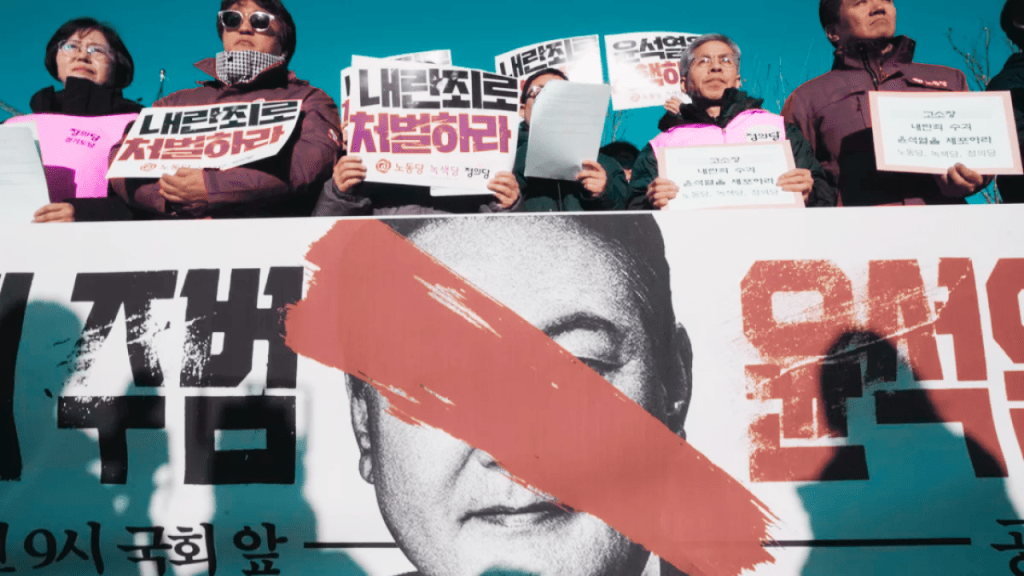
South Korea political crisis deepens as President Yoon faces impeachment. The Constitutional Court’s decision could trigger early elections in 2025.
South Korea is experiencing a significant political upheaval following President Yoon Suk Yeol’s controversial attempt to impose martial law on December 3, 2024.
The move, which was swiftly overturned, ignited widespread outrage and led to Yoon’s impeachment by the National Assembly on December 14, 2024. Now, the Constitutional Court is tasked with deciding whether to officially remove Yoon from office or reinstate his powers, a decision that could reshape the country’s political future.
The current crisis follows a steady decline in Yoon’s political influence, particularly after the opposition Democratic Party (DP) secured a landslide victory in the April 2024 legislative elections.
The DP now holds 175 out of 300 seats in the National Assembly, providing them with a dominant majority. This shift has significantly weakened Yoon’s ability to advance his conservative agenda, as the balance of power in the legislature now leans heavily toward the liberals.
If the Constitutional Court upholds the impeachment and removes Yoon from office, South Korea will hold an early presidential election in 2025.
According to the country’s electoral laws, such an election must take place within 60 days of the president’s removal. Given the public’s mounting dissatisfaction with Yoon’s leadership, the opposition Democratic Party is poised to make further gains, consolidating their influence over both the legislative and executive branches of government.
At the forefront of the Democratic Party is its leader, Lee Jae-myung, who is widely considered the frontrunner for the presidency. Lee has consistently been a vocal critic of Yoon’s administration and its policies.
However, Lee himself faces legal challenges that could complicate his path to leadership. Despite these issues, the combination of the DP’s strong parliamentary majority and overwhelming public support for Yoon’s impeachment has strengthened Lee’s position heading into a potential early election.
Public opinion has played a critical role in shaping the current crisis. Polls show that more than 70% of South Koreans support Yoon’s impeachment, reflecting deep discontent with his government.
This widespread dissatisfaction stems from Yoon’s handling of domestic issues, coupled with the extraordinary decision to impose martial law—an act that many viewed as undemocratic and authoritarian. For the Democratic Party, this sentiment represents a clear opportunity to solidify their control and push forward a more progressive agenda.
The political shift in South Korea signals a broader ideological transformation. The DP’s legislative dominance and the erosion of conservative power under Yoon suggest that the country is moving toward a more liberal political landscape. If Lee Jae-myung and the Democratic Party succeed in the next election, it could mark the beginning of a new era in South Korean politics—one defined by reforms and a departure from Yoon’s conservative policies.
As the Constitutional Court deliberates, the nation watches closely. The outcome of Yoon’s impeachment will not only determine his political fate but also set the stage for South Korea’s immediate future. With the opposition gaining momentum and public support overwhelmingly against Yoon, the likelihood of a Democratic Party victory in a potential early election appears increasingly certain.



 ElectionOdds.ca