
The latest Canada election popular vote odds strongly favor the liberals at -225, their best chance at securing the popular vote since trudeau’s 2015 win.
As Canadians prepare to head to the polls on April 28, 2025, the political betting markets have undergone a dramatic transformation. Once heavily favored, Pierre Poilievre’s Conservatives have seen their odds collapse in spectacular fashion, while the Liberal Party, under the new leadership of Mark Carney, has surged to its strongest position in a decade.
The latest betting odds show the Liberal Party at -225 to win the popular vote, reflecting a 69.2% implied probability of victory. This marks the Liberals’ best chance at securing the popular vote since Justin Trudeau’s breakthrough 2015 campaign. Meanwhile, the Conservatives have fallen to +138 odds — a stark reversal from their once-dominant standing in early 2024.
Betting Odds Breakdown
| Party | Odds | Implied Probability |
|---|---|---|
| Liberal Party (LPC) | -225 | 69.2% |
| Conservative Party (CPC) | +138 | 42.0% |
| Any Other Party | +6600 | 1.5% |
(Odds updated as of April 28, 2025)
In simple terms, a $225 bet on the Liberals would return $100 in profit if they win, while a $100 bet on the Conservatives would yield a $138 profit if they pull off an upset. However, the gap between the two parties has widened sharply, reflecting growing market confidence in a Liberal victory.
How We Got Here: The Key Shifts
Several major developments have fueled this reversal of fortunes.
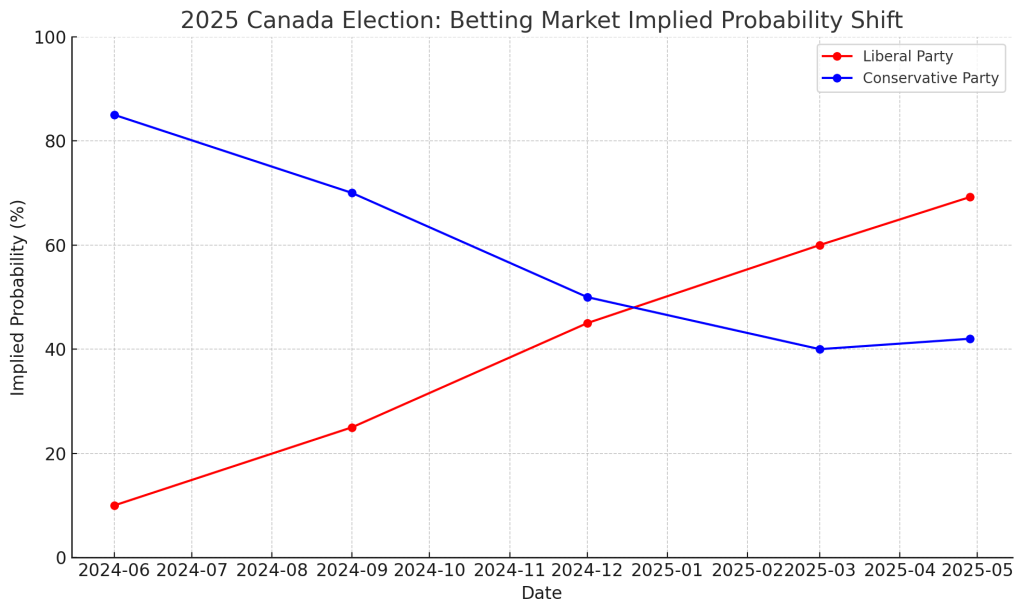
The first was the leadership transition. Following Justin Trudeau’s resignation in mid-2024, Mark Carney — former Governor of the Bank of Canada and Bank of England — took over the Liberal Party. His reputation for economic competence resonated with a Canadian public increasingly anxious about a looming trade war with Donald Trump’s United States.
Seizing the moment, Carney called a snap election, capitalizing on the Liberals’ early surge in polls. At the same time, the Conservative Party became bogged down by internal divisions, high-profile candidate scandals, and backlash over its association with reactionary elements emboldened by American politics.
Polling numbers reflected the shift. In the final weeks before the election, an Angus Reid survey showed the Liberals pulling ahead nationally with 46% support, compared to the Conservatives’ 38% — an eight-point gap that would almost certainly deliver the Liberals not just a victory, but a possible majority government.
Province-by-Province Overview
The Liberals’ resurgence isn’t limited to one region. Betting markets project strong performances across most of the country:
- Ontario (122 seats): Liberals lead Conservatives by six points and are projected to dominate urban and suburban ridings.
- Quebec (78 seats): Liberal national unity messaging has blunted the Bloc Québécois’s momentum.
- British Columbia (42 seats): Liberals are slight favorites, but Conservatives remain competitive in rural districts.
- Alberta (34 seats): Conservatives maintain dominance but are isolated geographically.
- Saskatchewan (14 seats): Conservatives remain strong.
- Manitoba (14 seats): Urban-rural split gives both parties chances.
- Atlantic Canada (32 seats): Liberals continue their historical dominance.
- Territories (3 seats): Liberals are favored in Yukon and Northwest Territories; Conservatives competitive in Nunavut.
Overall, while the Conservatives are holding ground in traditional strongholds like Alberta and Saskatchewan, they are failing to make meaningful gains in the battleground provinces that ultimately decide Canadian elections.
The Historical Collapse of Conservative Momentum
The speed and magnitude of the Conservatives’ collapse have few historical parallels in Canadian politics.
In January 2025, the Conservatives were listed at odds of -2000 to win — implying over a 95% chance of victory. Now, they find themselves significant underdogs. This is not merely a slip; it is one of the most dramatic implosions of a favored party in Canadian election history.
The Conservatives’ regional successes — particularly in Alberta — cannot mask their national failure. To win federally, a party must build a cross-country coalition. The Conservatives’ increasingly isolated and polarizing message has alienated voters in Ontario, Quebec, and British Columbia, where elections are truly decided.
A Liberal Victory Within Reach
While political betting odds are no guarantee of election outcomes, they are an important snapshot of public sentiment and informed wagering. As of April 28, 2025, the Liberals stand on the cusp of a major victory — one that would reestablish them as Canada’s dominant political force after years of decline.
Meanwhile, Pierre Poilievre’s Conservatives appear poised to squander one of the most favorable political environments an opposition party has ever enjoyed — a collapse that, if realized on election day, will be remembered as one of the most historic failures in Canadian political history.
The final verdict will come when Canadians cast their votes. But as of today, the markets have made up their minds: this is Mark Carney’s election to lose.



 ElectionOdds.ca
Leave a comment